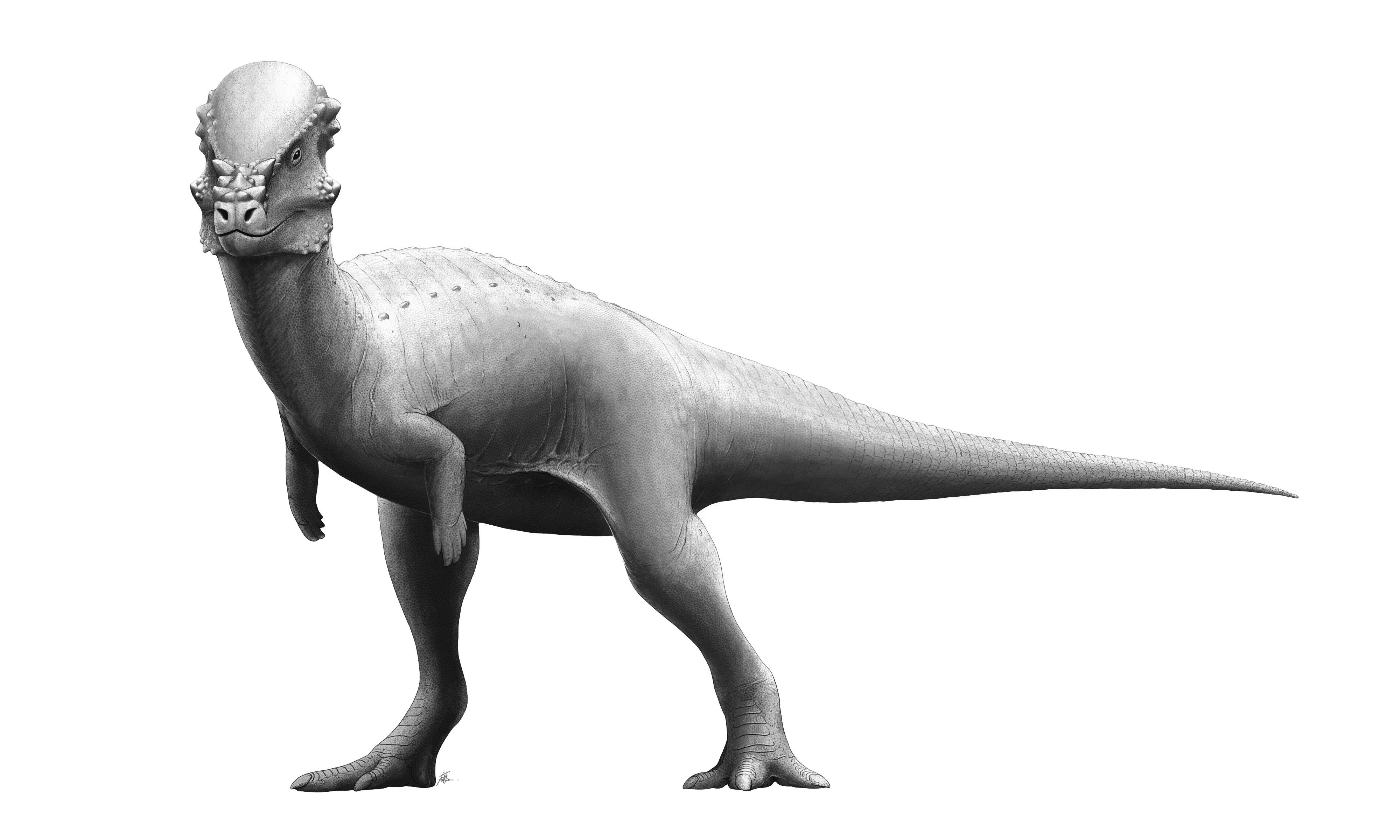
Stygimoloch
The "horned demon from the river of death" — a name still in popular use, but probably the juvenile stage of _Pachycephalosaurus_ rather than its own genus.
Range: North America
Description
Stygimoloch spinifer, whose name translates to "spiked demon from the Styx," was named in 1983. The description was based on skull remains from the Hell Creek Formation that featured a flat or slightly rounded cranium surrounded by unusually long, sharp spikes. At the time, this unique combination of traits seemed to distinguish it from any known adult pachycephalosaurid, justifying the creation of a new genus.
In 2009, Jack Horner and Mark Goodwin published a study in PLOS ONE arguing that Stygimoloch and another genus, Dracorex hogwartsia, were actually juvenile stages of Pachycephalosaurus wyomingensis. According to their research, as the animal matured, its long spikes were absorbed by the bone while the skull dome thickened into its adult form. This theory is now the leading interpretation, though some researchers, like Robert Sullivan, continue to view Stygimoloch as a distinct genus.
If the synonymy is correct, the Stygimoloch specimens represent sub-adults measuring about 3 m long and weighing around 80 kg. Their characteristic spikes would have functioned as display structures during an intermediate growth phase before the massive skull dome fully developed.
Behaviour & ecology
If Stygimoloch is indeed a younger Pachycephalosaurus, its behaviour can be understood as part of a dramatic developmental sequence. The long spikes of the sub-adult stage may have served for anti-predator deterrence, species recognition, or display within its peer group. As the dinosaur reached maturity and the dome grew thicker, its ecological role likely shifted toward the head-butting or flank-butting combat seen in adults. This transition is one of the most thoroughly documented examples of changing morphology as a dinosaur aged.
Notable specimens
- UCMP 119435 — Galton & Sues holotype, University of California Museum of Paleontology.
- MPM VP7585 — Milwaukee Public Museum sub-adult specimen, well-preserved.
- The specimen "Sandy" / "Skip" (now considered sub-adult Pachycephalosaurus) — Milwaukee Public Museum.
Scientific debates
Genus validity — Horner & Goodwin (2009) argue Stygimoloch is a sub-adult Pachycephalosaurus; Sullivan and others argue for genus retention. The synonymy is the dominant view but not universal. Dome-vs-spike trade-off — the ontogenetic resorption of long spikes alongside dome thickening is well-documented and supports the synonymy. Functional ecology of sub-adult morphology — display vs species recognition vs combat; consensus tilts toward display.
In popular culture
Stygimoloch remains in popular use partly because of the dramatic name and the striking spiky-skull appearance of the holotype morphology. It appears in Jurassic World: Fallen Kingdom (2018) as a "Stiggy" character. The 2009 ontogenetic synonymy got significant popular-science coverage.
Further reading
- Galton, P. M., & Sues, H.-D. (1983). New data on pachycephalosaurid dinosaurs from North America. Canadian Journal of Earth Sciences, 20, 462–472.
- Horner, J. R., & Goodwin, M. B. (2009). Extreme cranial ontogeny in the Upper Cretaceous Dinosaur Pachycephalosaurus. PLOS ONE, 4, e7626.
- Sullivan, R. M. (2003). Revision of the dinosaur Stegoceras Lambe (Ornithischia, Pachycephalosauridae). Journal of Vertebrate Paleontology, 23, 181–207.
- Bakker, R. T., et al. (2006). Dracorex hogwartsia, n. gen., n. sp., a spiked, flat-headed pachycephalosaurid dinosaur from the Upper Cretaceous Hell Creek Formation. New Mexico Museum of Natural History and Science Bulletin, 35, 331–345.
Image gallery
Specimens, fossils, and reconstructions. License and attribution shown on every plate.
skeleton · 2 images


life restoration · 2 images
 life restoration
 life restoration
anatomy · 10 images
 anatomy
 anatomy
 anatomy
 anatomy
 anatomy
 anatomy
 anatomy
 anatomy
 anatomy
size comparison · 1 images
 size comparison


Scientific literature
Peer-reviewed papers cited in this profile, drawn from OpenAlex and Crossref. Open-access PDFs flagged where available.
Extreme Cranial Ontogeny in the Upper Cretaceous Dinosaur Pachycephalosaurus
John R. Horner, Mark B. Goodwin · PLoS ONE
BACKGROUND: Extended neoteny and late stage allometric growth increase morphological disparity between growth stages in at least some dinosaurs. Coupled with relatively low dinosaur density in the Upper Cretaceous of North America, ontogenetic transformational representatives are often difficult to distinguish. For exa…
Revision of the dinosaur<i>Stegoceras</i>Lambe (Ornithischia, Pachycephalosauridae)
Robert M. Sullivan · Journal of Vertebrate Paleontology
ABSTRACT Stegoceras (sensu lato) has been the recipient of a number of species. Most have been placed into synonymy with S. validum, some have been transferred to other genera (i.e., Gravitholus, Ornatotholus), whereas others have been interpreted as being sexual dimorphs. A parsimonious phylogenetic analysis using 49 …
Cranial Ontogeny in Stegoceras validum (Dinosauria: Pachycephalosauria): A Quantitative Model of Pachycephalosaur Dome Growth and Variation
Ryan K. Schott, David C. Evans, Mark B. Goodwin · PLoS ONE
Historically, studies of pachycephalosaurs have recognized plesiomorphically flat-headed taxa and apomorphically domed taxa. More recently, it has been suggested that the expression of the frontoparietal dome is ontogenetic and derived from a flat-headed juvenile morphology. However, strong evidence to support this hyp…
A new genus of derived pachycephalosaurian from western North America
Thomas E. Williamson, Thomas D. Carr · Journal of Vertebrate Paleontology
ABSTRACT Pachycephalosaurian specimens from the Upper Cretaceous (upper Campanian) Kirtland Formation of northwestern New Mexico include a partial skull that preserves much of the basicranium. It represents a new genus and species, Sphaerotholus goodwini. A new species, S. buchholtzae, from the upper Maastrichtian Hell…
Reconstructions of the Axial Muscle Insertions in the Occipital Region of Dinosaurs: Evaluations of Past Hypotheses on Marginocephalia and Tyrannosauridae Using the Extant Phylogenetic Bracket Approach
Takanobu Tsuihiji · The Anatomical Record
The insertions of the cervical axial musculature on the occiput in marginocephalian and tyrannosaurid dinosaurs have been reconstructed in several studies with a view to their functional implications. Most of the past reconstructions on marginocephalians, however, relied on the anatomy of just one clade of reptiles, Le…
3D model
Rendered from a third-party scan. The viewer loads on click so the page stays fast.
AllThingsSaurus · CC Attribution
Further reading
Curated books and field guides. Some links earn us a small Amazon commission — supports the library, never your price.
Bring Stygimoloch home — a hand-painted figurine vetted by the library.
Shop Stygimoloch figurine →Silhouette: Emily Willoughby e.deinonychus · https://creativecommons.org/licenses/by-sa/3.0/ · PhyloPic