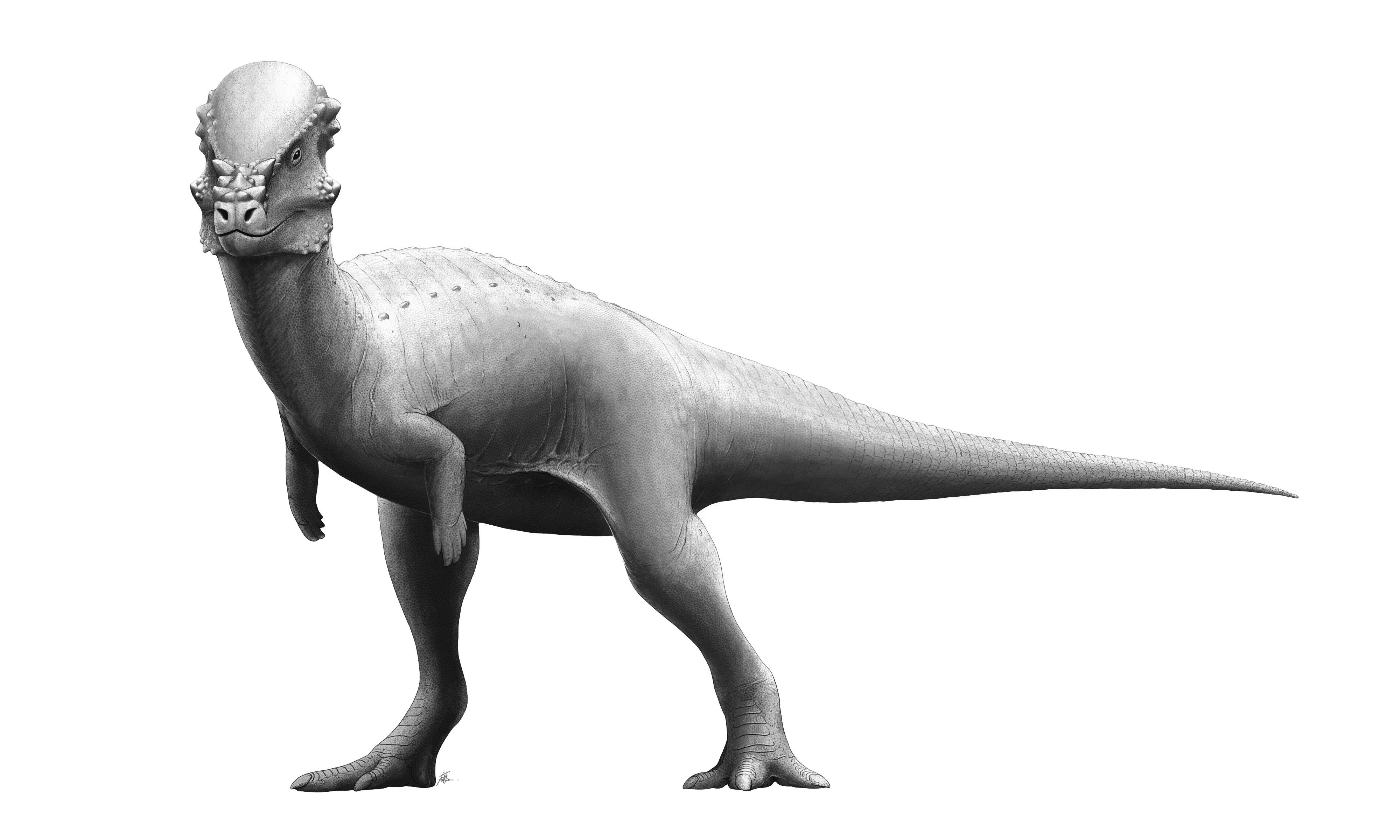
Pachycephalosaurus
The 25-cm-thick skull dome — the largest pachycephalosaur, the iconic dome-headed dinosaur of the Hell Creek, and the centre of one of paleontology's most-debated combat-behaviour puzzles.
Range: North America
Popular Pachycephalosaurus products
Sponsored — as an Amazon Associate, dinolibrary earns from qualifying purchases.
Description
Pachycephalosaurus wyomingensis is the largest member of its clade. It possessed a frontoparietal skull dome measuring up to 25 cm thick, the greatest of any known dinosaur. A halo of nodes and short spikes surrounded this central dome, with additional spikes located along the postorbital and squamosal areas. The dome grew significantly as the animal matured. Juveniles started with flat skulls and longer spikes, a morphology previously used to define the genera Stygimoloch and Dracorex. These are now generally understood to be younger stages of Pachycephalosaurus.
The dinosaur moved on two legs and had relatively short forelimbs, sturdy hindlimbs, and a stiff tail. Its mouth contained small, leaf-shaped cheek teeth and sharp, canine-like front teeth. This dental arrangement suggests a varied diet that likely included plants, insects, and perhaps small vertebrates. Complete skeletons are rare because the dense bone of the skull dome preserves far more effectively than the rest of the body.
Behaviour & ecology
The purpose of the thick skull dome is the subject of three primary theories:
- Head-butting: This theory proposes frontal-impact combat similar to modern bighorn sheep. It is supported by the dome's thickness and internal shock-absorbing structure (Snively & Cox 2008).
- Flank-butting: This hypothesis suggests that individuals used their heads for sideways shoves. Biomechanical studies of the neck and spine indicate that the braincase was not perfectly aligned for direct head-on impacts.
- Display: Some researchers argue the dome functioned primarily for sexual display or species recognition, citing a lack of definitive combat injuries in many fossils.
However, a 2013 study by Peterson et al. identified healed cranial injuries on several skulls that are consistent with intraspecific impacts. Most paleontologists now accept that the dome was used for some form of combat, though it undoubtedly played a role in display and recognition as well.
Notable specimens
- UCMP 130051 — P. wyomingensis holotype, University of California Museum of Paleontology.
- MPM VP6135 ("Sandy"-type specimen) — Milwaukee Public Museum.
- MPM VP7585 ("Stygimoloch"-stage juvenile) — now considered juvenile P. wyomingensis.
Scientific debates
Stygimoloch and Dracorex synonymy — Horner & Goodwin (2009) argue both are juvenile Pachycephalosaurus; widely (but not universally) accepted. Combat behaviour — head-butting vs flank-butting vs display only; current consensus: combat plus display, with flank-butting probably more common than direct head-on impact. Dome growth pattern — well-resolved as ontogenetic thickening.
In popular culture
Pachycephalosaurus is a fixture of dinosaur toy lines, almost always shown head-butting. Jurassic Park: The Lost World (1997) features one breaking out of its enclosure. The animal is one of the canonical Hell Creek species alongside T. rex, Triceratops, Edmontosaurus, and Ankylosaurus.
Further reading
- Horner, J. R., & Goodwin, M. B. (2009). Extreme cranial ontogeny in the Upper Cretaceous Dinosaur Pachycephalosaurus. PLOS ONE, 4, e7626.
- Snively, E., & Cox, A. (2008). Structural mechanics of pachycephalosaur crania. Acta Palaeontologica Polonica, 53, 581–599.
- Schott, R. K., et al. (2011). Cranial ontogeny in Stegoceras validum. PLOS ONE, 6, e21092.
- Peterson, J. E., Dischler, C., & Longrich, N. R. (2013). Distributions of cranial pathologies provide evidence for head-butting in dome-headed dinosaurs. PLOS ONE, 8, e68620.
Image gallery
Specimens, fossils, and reconstructions. License and attribution shown on every plate.
skeleton · 2 images


fossil · 1 images
 fossil
life restoration · 2 images
 life restoration
 life restoration
anatomy · 8 images
 anatomy
 anatomy
 anatomy
 anatomy
 anatomy
 anatomy
 anatomy
%2C_Royal_Tyrrell_Museum%2C_Drumheller%2C_Alberta%2C_2025-07-13.jpg) anatomy
anatomysize comparison · 1 images
 size comparison


Scientific literature
Peer-reviewed papers cited in this profile, drawn from OpenAlex and Crossref. Open-access PDFs flagged where available.
Extreme Cranial Ontogeny in the Upper Cretaceous Dinosaur Pachycephalosaurus
John R. Horner, Mark B. Goodwin · PLoS ONE
BACKGROUND: Extended neoteny and late stage allometric growth increase morphological disparity between growth stages in at least some dinosaurs. Coupled with relatively low dinosaur density in the Upper Cretaceous of North America, ontogenetic transformational representatives are often difficult to distinguish. For exa…
Revision of the dinosaur<i>Stegoceras</i>Lambe (Ornithischia, Pachycephalosauridae)
Robert M. Sullivan · Journal of Vertebrate Paleontology
ABSTRACT Stegoceras (sensu lato) has been the recipient of a number of species. Most have been placed into synonymy with S. validum, some have been transferred to other genera (i.e., Gravitholus, Ornatotholus), whereas others have been interpreted as being sexual dimorphs. A parsimonious phylogenetic analysis using 49 …
A new genus of derived pachycephalosaurian from western North America
Thomas E. Williamson, Thomas D. Carr · Journal of Vertebrate Paleontology
ABSTRACT Pachycephalosaurian specimens from the Upper Cretaceous (upper Campanian) Kirtland Formation of northwestern New Mexico include a partial skull that preserves much of the basicranium. It represents a new genus and species, Sphaerotholus goodwini. A new species, S. buchholtzae, from the upper Maastrichtian Hell…
Cranial Pathologies in a Specimen of Pachycephalosaurus
Joseph E. Peterson, Christopher P. Vittore · PLoS ONE
BACKGROUND: A frontoparietal dome of a large pachycephalosaurid collected from the Upper Cretaceous Hell Creek Formation in 2001 is identified as Pachycephalosaurus wyomingensis. The specimen features two large oval depressions on the dorsal surface, accompanied by numerous circular pits on the margin and inner surface…
Cranial anatomy and diagnosis of<i>Stygimoloch spinifer</i>(Ornithischia: Pachycephalosauria) with comments on cranial display structures in agonistic behavior
Mark B. Goodwin, Emily A. Buchholtz, Rolf E. Johnson · Journal of Vertebrate Paleontology
ABSTRACT A new skull of Stygimoloch spinifer (MPM 8111) from the Upper Cretaceous Hell Creek Formation of North Dakota is the most complete specimen discovered to date. It allows much of the skull and braincase of this unusual pachycephalosaurid to be described for the first time and confirms a suite of diagnostic char…
3D model
Rendered from a third-party scan. The viewer loads on click so the page stays fast.
ferociousindustries.matthias · CC Attribution
Further reading
Curated books and field guides. Some links earn us a small Amazon commission — supports the library, never your price.
Bring Pachycephalosaurus home — a hand-painted figurine vetted by the library.
Shop Pachycephalosaurus figurine →Silhouette: Emily Willoughby e.deinonychus · https://creativecommons.org/licenses/by-sa/3.0/ · PhyloPic