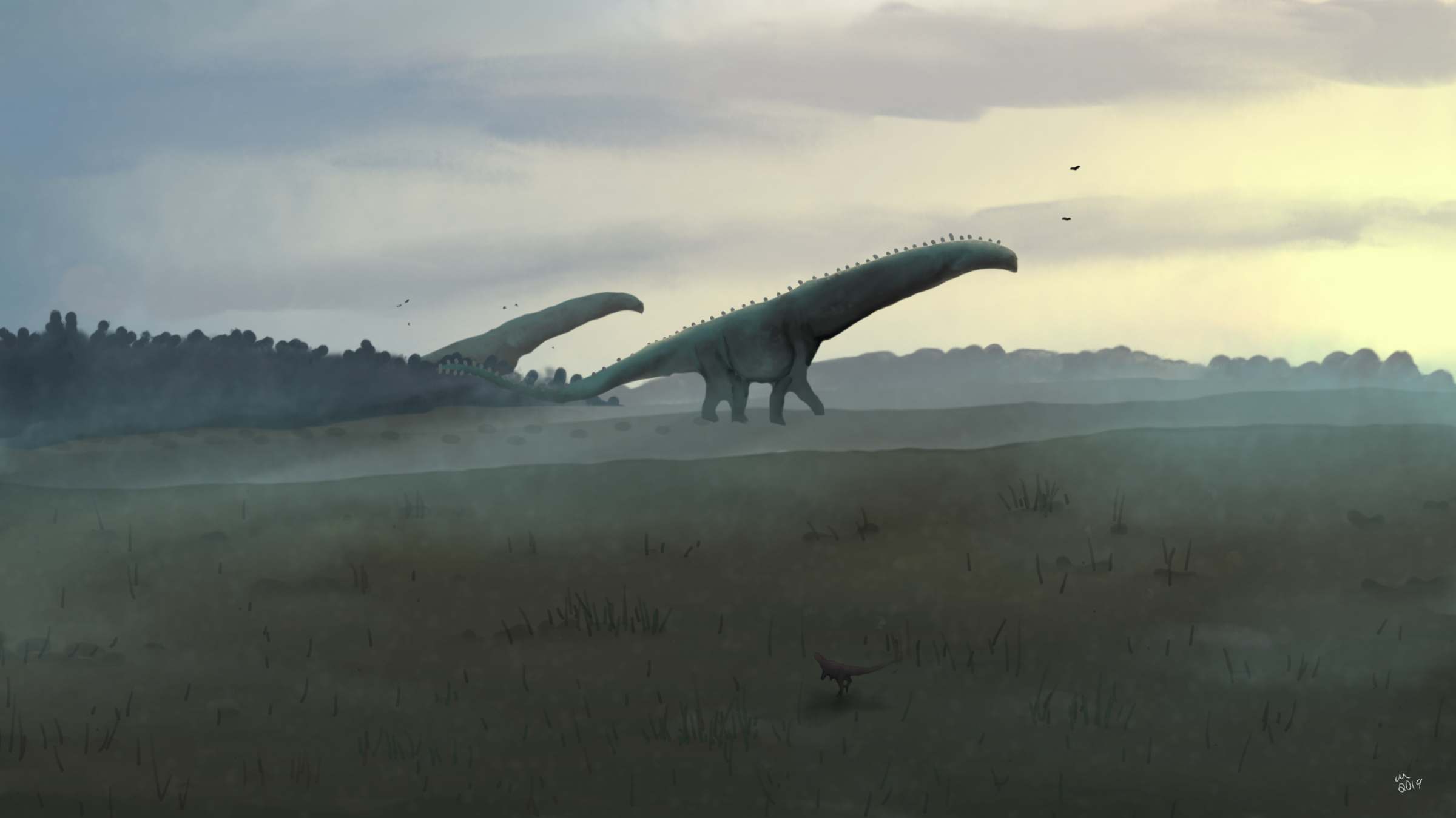
Patagotitan
The Patagonian titan — known from a richer fossil sample than any of its giant cousins, and the basis for some of the most-replicated giant sauropod skeletons in the world.
Range: South America (Argentina)
Description
Patagotitan mayorum is a exceptionally well-preserved giant titanosaur. Its description is based on at least six young adult individuals, which together represent about 70% of the skeleton. When first announced, estimates suggested it was the largest dinosaur ever found, reaching 37 m in length and weighing nearly 70 tonnes. However, later studies by Otero et al. (2020) and Paul (2019) revised these figures down to approximately 31 m and 50–60 tonnes. These new estimates place Patagotitan in the same size category as its relatives Argentinosaurus and Puertasaurus.
The animal's anatomy is typical of the Lognkosauria, a group of broad-bodied titanosaurs with widely spaced, columnar limbs and a sturdy torso. Its vertebrae featured large pneumatic chambers, and its neck was likely between 12 and 15 m long. Unlike diplodocids, it had a relatively short tail. The holotype's completeness, which includes full femora and pelvic elements, has allowed scientists to produce more accurate body-mass estimates than are possible for many other giants.
The American Museum of Natural History in New York features a famous full-skeleton mount of the genus. This reconstruction is so long that its head must extend into a corridor to fit within the display gallery.
Behaviour & ecology
Patagotitan inhabited the lush floodplains of mid-Cretaceous Patagonia. Its diet consisted of conifers, ferns, cycads, and early flowering plants. The discovery of six individuals at the same site suggests that these dinosaurs lived in groups. Bone histology shows they followed a fast-growth strategy, reaching sexual maturity at around 30 years of age and continuing to grow after that. An adult's massive size provided protection against all but the largest predators, leaving only the juveniles at risk.
Biomechanical models of its long neck (Sellers et al. 2013) suggest that Patagotitan could feed across a broad horizontal arc while standing still. This ability helped it conserve energy, giving it an advantage over smaller, more active browsers.
Notable specimens
- MPEF-PV 3399 — holotype, Museo Paleontológico Egidio Feruglio, Trelew, Argentina; substantial multi-individual material.
- AMNH cast — full-skeleton replica at the American Museum of Natural History, New York; one of the largest mounted dinosaurs in the world.
- Field Museum cast — Field Museum of Natural History, Chicago.
Scientific debates
Mass estimate — initial 2017 figures of ~70 tonnes were revised down to ~50–60 tonnes by 2020. Length — initial 37 m revised down to ~31 m. Comparison with Argentinosaurus — Patagotitan and Argentinosaurus are now considered close in size, with the "largest dinosaur" title contested between them and the older fragmentary giants. Phylogenetic position within Lognkosauria — well-supported as close to Argentinosaurus and Puertasaurus.
In popular culture
Patagotitan received major media coverage at its 2014 announcement (when initial size estimates suggested it was the largest dinosaur ever) and at its 2017 formal description. The AMNH mount is one of the museum's flagship exhibits and a popular Instagram subject.
Further reading
- Carballido, J. L., et al. (2017). A new giant titanosaur sheds light on body mass evolution among sauropod dinosaurs. Proc. R. Soc. B, 284, 20171219.
- Otero, A., et al. (2020). Forelimb posture in Patagotitan mayorum. Acta Palaeontologica Polonica, 65, 461–479.
- Paul, G. S. (2019). Determining the largest known land animal: a critical comparison of differing methods for restoring the volume and mass of extinct animals. Annals of Carnegie Museum, 85, 335–358.
- Sellers, W. I., et al. (2013). March of the titans: the locomotor capabilities of sauropod dinosaurs. PLOS ONE, 8, e78733.
Image gallery
Specimens, fossils, and reconstructions. License and attribution shown on every plate.
skeleton · 3 images

![Life restoration of Patagotitan mayorum. This reconstruction is primarily based on the set of fossil specimen refered to this genus on the 2017 description.[1] Proportions were based on the skeletal diagram from the description, [1] and the one made by Scott Hartmann. The limbs were traced, measured, and modified to match the fossils described on the 2020 appendicular osteology study.[2] Additionally, images of the fossils created by Ulises José Sosa (3D model) and Gastón Cuello (unedited photog](https://commons.wikimedia.org/wiki/File:Patagotitan_mayorum.jpg)

life restoration · 3 images
 life restoration
 life restoration
 life restoration
anatomy · 1 images
 anatomy
other · 9 images
 other
other other
other.jpg) other
other other
other other
other other
other other
other other
other other
otherScientific literature
Peer-reviewed papers cited in this profile, drawn from OpenAlex and Crossref. Open-access PDFs flagged where available.
Osteology of the Late Cretaceous Argentinean sauropod dinosaur Mendozasaurus neguyelap: implications for basal titanosaur relationships
Bernardo J. González Riga, Philip D. Mannion, Stephen F. Poropat · Zoological Journal of the Linnean Society
The titanosaurian sauropod dinosaur Mendozasaurus neguyelap is represented by several partial skeletons from a single locality within the Coniacian (lower Upper Cretaceous) Sierra Barrosa Formation in the south of Mendoza Province, northern Neuquén Basin, Argentina. A detailed revision of Mendozasaurus, including previ…
Paleontological discoveries in the Chorrillo Formation (upper Campanian-lower Maastrichtian, Upper Cretaceous), Santa Cruz Province, Patagonia, Argentina
Fernando E. Novas, Federico L. Agnolín, Sebastián Rozadilla · Revista del Museo Argentino de Ciencias Naturales
The first fossil remains of vertebrates, invertebrates, plants and palynomorphs of the Chorrillo Formation (Austral Basin), about 30km to the SW of the town of El Calafate (Province of Santa Cruz), are described. Fossils include the elasmarian (basal Iguanodontia) Isasicursor santacrucensis gen. et sp. nov., the large …
Two Late Cretaceous sauropods reveal titanosaurian dispersal across South America
E. Martín Hechenleitner, Léa Leuzinger, Agustín G. Martinelli · Communications Biology
South American titanosaurians have been central to the study of the evolution of Cretaceous sauropod dinosaurs. Despite their remarkable diversity, the fragmentary condition of several taxa and the scarcity of records outside Patagonia and southwestern Brazil have hindered the study of continental-scale paleobiogeograp…
The Appendicular Osteology of<i>Patagotitan Mayorum</i>(Dinosauria, Sauropoda)
Alejandro Otero, José Luis Carballido, Agustín Pérez Moreno · Journal of Vertebrate Paleontology
Its huge size, excellent preservation, and completeness make Patagotitan mayorum a unique opportunity to explore the anatomy, paleobiological, and phylogenetic aspects linked to gigantism within Sauropoda. In this regard, we describe the appendicular skeleton of this titanosaurian species from the late Albian-aged Cerr…
Report of a giant titanosaur sauropod from the Upper Cretaceous of Neuquén Province, Argentina
Alejandro Otero, José Luis Carballido, Leonardo Salgado · Cretaceous Research
3D model
Rendered from a third-party scan. The viewer loads on click so the page stays fast.
lautaro.cb · CC Attribution-ShareAlike
Further reading
Curated books and field guides. Some links earn us a small Amazon commission — supports the library, never your price.