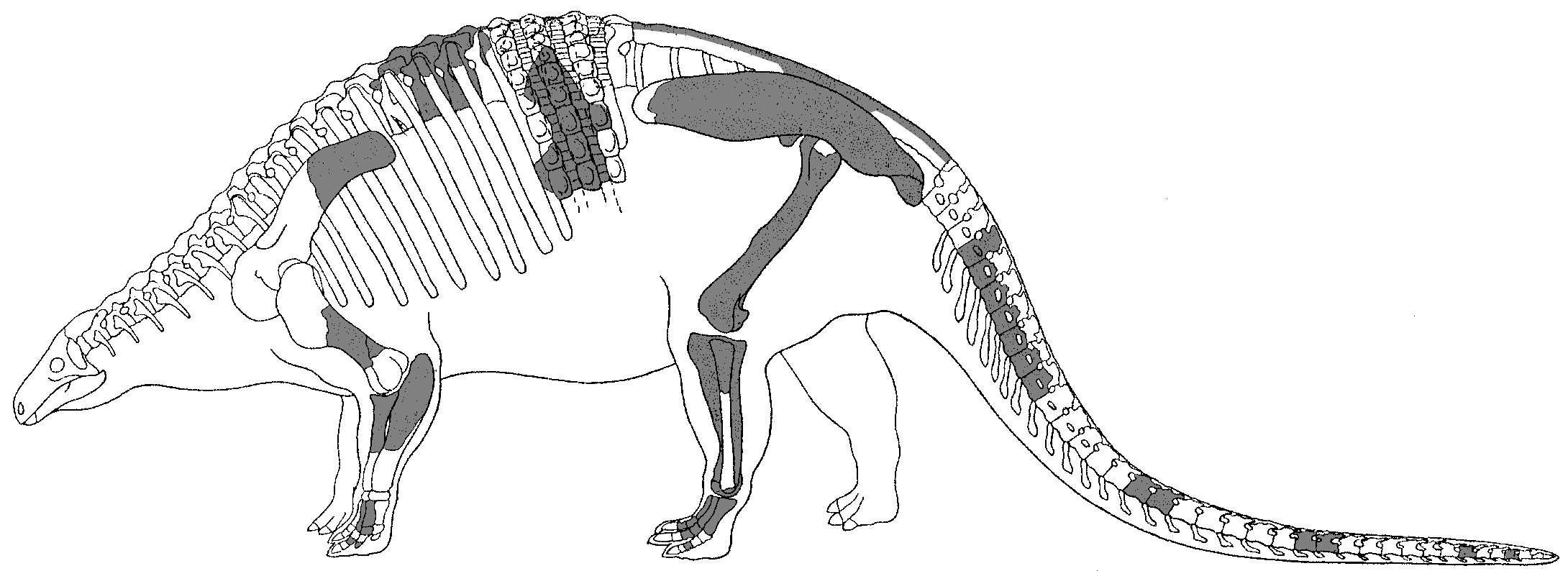
Nodosaurus
The "knobbed lizard" — the eponymous nodosaurid, club-less but heavily armoured, and the namesake of the entire club-less ankylosaur subfamily.
Range: North America
Description
Nodosaurus textilis is the type and only widely recognized species within the genus Nodosaurus, which gives its name to the family Nodosauridae. Its name translates to "knobbed lizard," referring to the bony nodes that covered its back. The species name textilis describes the woven, fabric-like appearance of this tightly packed armour.
This moderate-sized herbivore grew to about 6 m in length and weighed approximately 3.5 tonnes. It is distinguished from its close relatives, the ankylosaurids, by the absence of a tail club. Instead, nodosaurids had flexible, weaponless tails. To compensate, they often possessed larger lateral spikes, especially on the shoulders, to provide protection along their flanks.
The dinosaur's dorsal armour was made of numerous small osteoderms that formed a shield over its back and tail. Larger, ridged scutes and conical spikes ran along its sides. Evidence from related fossils, such as the exceptionally preserved Borealopelta mummy, indicates that these bony plates were covered in keratinous sheaths. This would have increased the effective size and sharpness of the armour in life.
The skull of Nodosaurus was more pointed than those of its ankylosaurid cousins. Its narrow snout suggests it was a more selective feeder than the broad-beaked ankylosaurines.
Behaviour & ecology
During the Cenomanian, Nodosaurus inhabited the coastal environments of the Frontier Formation in Wyoming. These areas were characterized by conifer and fern forests with shallow marine influences. As a low-browsing herbivore, it likely ate ferns, low-lying conifers, and cycads. Its defensive strategy relied on its dense back armour and shoulder spikes. Unlike ankylosaurids, which could actively strike back with a tail club, nodosaurids likely crouched low to the ground when threatened, using their spiked flanks to deter predators.
The discovery of the Borealopelta specimen, a close relative, has provided new insights into nodosaurid biology. It preserved stomach contents, including ferns and charcoal, suggesting the animals fed in areas regrowing after fires. Analysis of its melanosomes also revealed reddish-brown countershading, the most detailed colour reconstruction for any non-avian dinosaur to date.
Notable specimens
- YPM 1815 — Marsh's holotype, Yale Peabody Museum.
- AMNH 3736 — referred specimen.
- Borealopelta markmitchelli (close relative, TMP 2011.033.0001) — Royal Tyrrell Museum; preserves intact armour, skin, gut contents, and countershading pigment.
Scientific debates
Genus and species count — N. textilis is the only universally accepted species; the genus is somewhat poorly diagnosed by modern standards because the holotype lacks a complete skull. Some workers consider Nodosaurus textilis a nomen dubium, though it remains in active use. Phylogenetic position within Nodosauridae — basal nodosaurid; well-resolved. Defensive strategy — flank-protection-and-crouch model is the dominant interpretation.
In popular culture
Nodosaurus is less famous than Ankylosaurus or even Borealopelta but is the namesake of an important ankylosaur subfamily. The 2017 Borealopelta unveiling at the Royal Tyrrell — a near-perfectly preserved nodosaurid that "looks like a sculpture rather than a fossil" — went viral globally and substantially raised public awareness of nodosaurids generally.
Further reading
- Lull, R. S. (1921). The Cretaceous armored dinosaur Nodosaurus textilis Marsh. American Journal of Science, 1, 97–126.
- Carpenter, K., & Kirkland, J. I. (1998). Review of Lower and middle Cretaceous ankylosaurs from North America. New Mexico Museum of Natural History and Science Bulletin, 14, 249–270.
- Brown, C. M., et al. (2017). An exceptionally preserved three-dimensional armored dinosaur reveals insights into coloration and Cretaceous predator-prey dynamics. Current Biology, 27, 2514–2521.
- Brown, C. M., et al. (2020). Dietary palaeoecology of an Early Cretaceous armoured dinosaur (Ornithischia; Nodosauridae). Royal Society Open Science, 7, 200305.
Image gallery
Specimens, fossils, and reconstructions. License and attribution shown on every plate.
skeleton · 3 images

![Illustration of Nodosaurus, an ankylosaurian dinosaur (North America, Cretaceous). This restoration is somewhat speculative and mostly based on closely related genera, as fossil remains of Nodosaurus are sparse.[1] Head: no skull have been recovered. In this restoration, the head is based on the skull of the closely related Pawpawsaurus.[2] Armour: Nodosaurus preserve some armour from the lumbar region its body.[1] The rest of is based on Sauropelta and Borealopelta (illustrations of body armour](https://commons.wikimedia.org/wiki/File:Nodosaurus_500_TWA.JPG)
![Life restoration of Acantholipan based in the skeletals diagrams of Nodosaurus and Sauropelta by GetAwayTrike (Genya Masukawa) [2]](https://commons.wikimedia.org/wiki/File:Acantholipan_LM.png)
fossil · 4 images
.jpg)
.jpg)
.jpg)
.jpg)

.jpg)
_(16411826393).jpg)
Scientific literature
Peer-reviewed papers cited in this profile, drawn from OpenAlex and Crossref. Open-access PDFs flagged where available.
An Exceptionally Preserved Three-Dimensional Armored Dinosaur Reveals Insights into Coloration and Cretaceous Predator-Prey Dynamics
Caleb M. Brown, Donald M. Henderson, Jakob Vinther · Current Biology
Predator-prey dynamics are an important evolutionary driver of escalating predation mode and efficiency, and commensurate responses of prey [1-3]. Among these strategies, camouflage is important for visual concealment, with countershading the most universally observed [4-6]. Extant terrestrial herbivores free of signif…
The Basal Nodosaurid Ankylosaur Europelta carbonensis n. gen., n. sp. from the Lower Cretaceous (Lower Albian) Escucha Formation of Northeastern Spain
James I. Kirkland, Luís Alcalá, Mark A. Loewen · PLoS ONE
Nodosaurids are poorly known from the Lower Cretaceous of Europe. Two associated ankylosaur skeletons excavated from the lower Albian carbonaceous member of the Escucha Formation near Ariño in northeastern Teruel, Spain reveal nearly all the diagnostic recognized character that define nodosaurid ankylosaurs. These new …
The phylogenetic nomenclature of ornithischian dinosaurs
Daniel Madzia, Victoria M. Arbour, Clint Boyd · PeerJ
are not to be applied retroactively, all phylogenetic definitions published prior to its implementation remain informal (and ineffective) in the light of the Code. Here, we revise the nomenclature of ornithischian dinosaur clades; we revisit 76 preexisting ornithischian clade names, review their recent and historical u…
A new armored dinosaur from the Cretaceous of Kansas
Theodore H. Eaton · KU ScholarWorks (The University of Kansas)
The skull and partial skeleton of an ankylosaur, family Nodosauridae, new genus and species, are described from the Terra Cotta clay member of the Dakota Formation (Cretaceous), Ottawa County, Kansas.The premaxillaries bear blunt, conical teeth; the pterygoids, although expanded posteriorly, do not fuse with the quadra…
The Cretaceous armored dinosaur, Nodosaurus textilis Marsh
R. S. Lull · American Journal of Science
3D model
Rendered from a third-party scan. The viewer loads on click so the page stays fast.
SemperAugustus · CC Attribution
Further reading
Curated books and field guides. Some links earn us a small Amazon commission — supports the library, never your price.
Bring Nodosaurus home — a hand-painted figurine vetted by the library.
Shop Nodosaurus figurine →