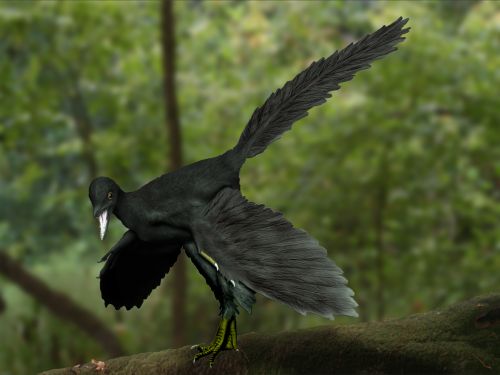
Archaeopteryx
The "Urvogel" — for over a century the textbook example of a transitional fossil, and still one of the most important specimens connecting dinosaurs to birds.
Range: Europe (Germany)
Popular Archaeopteryx products
Sponsored — as an Amazon Associate, dinolibrary earns from qualifying purchases.
Description
For more than a century, Archaeopteryx served as the definitive transitional fossil, providing a clear link between dinosaurs and birds. Found only two years after the publication of Darwin's On the Origin of Species, the Berlin specimen (HMN 1880) remains one of the most significant fossils ever studied. The animal exhibits a combination of dinosaurian and avian traits. Its skeleton includes a long bony tail, claws on three-fingered hands, conical teeth, and the gastralia typical of a small theropod. Conversely, its body and limbs were covered in pennaceous feathers, with asymmetric primary feathers on the wings and a vaned tail fan suitable for flight.
Taxonomists have named multiple species over the years. Current research (Foth et al. 2014; Foth & Rauhut 2017) generally recognises A. lithographica and perhaps one or two other species, as many specimens formerly treated as unique have been consolidated. Related genera like Wellnhoferia and Ostromia (the Haarlem specimen) are now classified separately.
While once viewed as the earliest known bird (Avialae), Archaeopteryx now shares the base of the avian tree with many other finds, such as Anchiornis, Aurornis, Xiaotingia, Eosinopteryx, and Baminornis. Some recent phylogenetic analyses place Archaeopteryx closer to non-avian deinonychosaurs. The distinction between calling it a "bird" or a "feathered dinosaur" depends largely on which taxonomic definitions a researcher follows.
Behaviour & ecology
Archaeopteryx inhabited a tropical archipelago known as the Solnhofen Lagoon. This environment consisted of warm, shallow lagoons and mudflats bordered by small islands. The Solnhofen Limestone has preserved a diverse range of pterosaurs, marine reptiles, fish, and rare land-dwelling vertebrates. Archaeopteryx likely acted as a generalist predator along forest edges. It was capable of at least short bursts of powered flight, a theory supported by Voeten et al. (2018). Their analysis of wing bone microstructure suggests flapping capabilities more akin to modern birds than to simple gliders.
Brain endocasts (Domínguez Alonso et al. 2004) show enlarged optic lobes and forebrains consistent with bird-like sensory ecology.
Notable specimens
There are at least 12 Archaeopteryx specimens, each named informally:
- London specimen (BMNH 37001, 1861) — Natural History Museum, London; the type.
- Berlin specimen (HMN 1880, 1875) — Museum für Naturkunde; most beautiful, with feather impressions.
- Maxberg specimen (lost 1991) — formerly Solnhofen-Museum.
- Eichstätt specimen (JM 2257, 1951) — Jura-Museum, Eichstätt.
- Solnhofen specimen (BMM A 1041, 1971) — Bürgermeister-Müller-Museum.
- Haarlem specimen (TM 6428, 1855) — now reassigned to Ostromia.
- Munich specimen (BSP 1999) — Bayerische Staatssammlung.
- Plus the Daiting, Thermopolis, Bürgermeister, and 2014 Munich specimens.
Scientific debates
Phylogenetic position — true bird (Avialae) vs deinonychosaur close to birds. Flight capability — Voeten et al. 2018 supports active flapping; older interpretations argued gliding only. Species splitting — multiple specimens, taxonomic instability over decades. Behaviour — arboreal vs ground-dwelling.
In popular culture
Archaeopteryx is the iconic transitional fossil, illustrated in essentially every evolution textbook and many natural history museums. Its cultural status as a symbol of evolutionary transition is unmatched among fossil organisms.
Further reading
- Wellnhofer, P. (2009). Archaeopteryx: The Icon of Evolution. Verlag Dr. Friedrich Pfeil.
- Foth, C., Tischlinger, H., & Rauhut, O. W. M. (2014). New specimen of Archaeopteryx provides insights into the evolution of pennaceous feathers. Nature, 511, 79–82.
- Voeten, D. F. A. E., et al. (2018). Wing bone geometry reveals active flight in Archaeopteryx. Nature Communications, 9, 923.
- Foth, C., & Rauhut, O. W. M. (2017). Re-evaluation of the Haarlem Archaeopteryx and the radiation of maniraptoran theropod dinosaurs. BMC Evolutionary Biology, 17, 236.
- Domínguez Alonso, P., et al. (2004). The avian nature of the brain and inner ear of Archaeopteryx. Nature, 430, 666–669.
Image gallery
Specimens, fossils, and reconstructions. License and attribution shown on every plate.
skeleton · 1 images
.jpg) skeleton
skeletonfossil · 14 images
.jpg) fossil
fossil.jpg) fossil
fossil.jpg) fossil
fossil.jpg) fossil
fossil.jpg) fossil
fossil.jpg) fossil
fossil.jpg) fossil
fossil.jpg) fossil
fossil.jpg) fossil
fossillife restoration · 3 images
 life restoration
 life restoration
.jpg) life restoration
life restorationother · 1 images
 other
otherScientific literature
Peer-reviewed papers cited in this profile, drawn from OpenAlex and Crossref. Open-access PDFs flagged where available.
Archaeopteryx and the origin of birds
John H. Ostrom · Biological Journal of the Linnean Society
The question of the origin of birds can be equated with the origin of Archaeopteryx, the oldest known bird. Analysis of the five presently known skeletal specimens of Archaeopteryx. and comparison with the skeletal anatomy of the several reptilian groups that have been proposed as possible ancestors of birds (Ornithopo…
A pre-Archaeopteryx troodontid theropod from China with long feathers on the metatarsus
Dongyu Hu, Lianhai Hou, Li‐Jun Zhang · Nature
An Archaeopteryx-like theropod from China and the origin of Avialae
Xing Xu, Hai‐Lu You, Kai Du · Nature
Archaeopteryx and the Origin of Flight
John H. Ostrom · The Quarterly Review of Biology
Reexamination of the specimens of Archaeopteryx, which constitute the only direct evidence pertaining to the habits and mode of life of the earliest stages of avian evolution, indicates that neither the highly favored arboreal theory nor the much critized cursorial theory offers adequate explanation for the origin of a…
New specimen of Archaeopteryx provides insights into the evolution of pennaceous feathers
Christian Foth, Helmut Tischlinger, Oliver W. M. Rauhut · Nature
3D model
Rendered from a third-party scan. The viewer loads on click so the page stays fast.
slang107123456789 · CC Attribution
Further reading
Curated books and field guides. Some links earn us a small Amazon commission — supports the library, never your price.
Bring Archaeopteryx home — a hand-painted figurine vetted by the library.
Shop Archaeopteryx figurine →Silhouette: T. Michael Keesey · https://creativecommons.org/publicdomain/zero/1.0/ · PhyloPic